
Video self-supervised models are almost always tested the same way: pre-train on Kinetics-400, finetune on something similar. The winner is called state of the art. But does winning there tell you how a model transfers?
In 2022 we showed that for 10 CNN methods, it doesn’t. Today’s models are transformers, so we asked again, of 22 models.
The problem
Below, each cell is a model’s rank on that dataset (1 = best). Models are grouped by family. If K400 predicted transfer, the shading would look the same in every column.
Finetuning, ranked among all 24 rows (supervised baselines included). Within CNNs, K400 rank says almost nothing about EK-100 rank (Spearman ρ = +0.10).
Who we tested
10 CNNs, 7 video-only transformers and 5 video-text transformers, all public checkpoints, all evaluated with one downstream protocol. This benchmarks off-the-shelf models; it is not a controlled study.
I · Domain
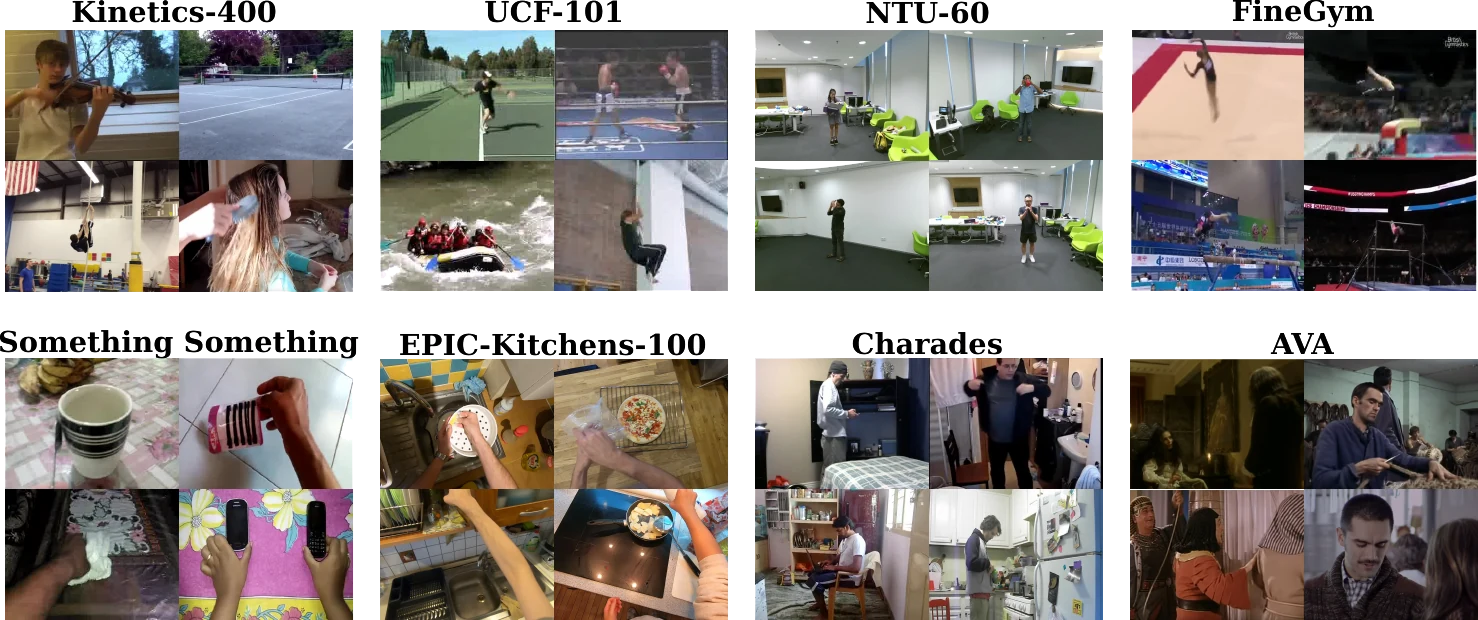
How far from Kinetics? Six datasets, from familiar (UCF-101) to far away (EPIC-Kitchens, FineGym, SS-v2).
Compare any two evaluations
Each dot is a model. Tap one to pin its label.
Finetuning accuracy (%)
Linear-probe accuracy (%)
Takeaway. Transformers handle domain shift better than CNNs. Video-text models, despite far more pre-training data, trail video-only ones on Gym-99, SS-v2 and EK-100.
II · Samples
Only 1,000 labelled clips? Accuracy with 1,000 finetuning samples versus all of them.
Takeaway. With all the data, models look alike. With 1k samples they spread out and reshuffle. Supervised CNN pre-training is the one to beat, and CNNs often beat transformers.
III · Actions
Telling similar actions apart: FineGym subsets, from coarse to near-identical classes.
Takeaway. Rankings change between subsets. The best CNNs beat the best video-only transformers on almost every one. Invariance to time reversal (GDT) hurts on UB-S1.
IV · Tasks
Beyond classification: detection, counting, arrow of time and localization. The last three columns leave the Kinetics domain.
Repetition counting is an error, so lower is better (shading accounts for this). Cross-family gaps are indicative only.
Takeaway. Recognition accuracy says little about counting or localization. Video-only transformers are the most consistent; video-text models win only on multi-label recognition (UMT).
Does Kinetics-400 predict anything?
Rank correlation (Spearman ρ) between each model’s K400 finetuning accuracy and its score on each setting.
Supervised baselines excluded (no K400 finetuning score). Video-text has only 5 models.
Pooled, K400 predicts UCF-101, SS-v2 and EK-100 (ρ ≥ 0.78), mostly because transformers beat CNNs on all three. On Gym-99 and every action subset it is anti-correlated (ρ ≈ −0.5). Within CNNs, it fades with domain distance: +0.78 on UCF-101, +0.10 on EK-100.
Who wins where
Takeaways
- No clear winner. Nothing is best across the board.
- Transformers aren’t best everywhere. More robust to domain and task shift; behind CNNs on fine-grained actions and low data.
- Video-only matches video-text. 240K Kinetics videos do as well as millions of pairs.
- Supervised still matters for CNNs. Especially with few samples, or when domain and task both change.
- Some invariances hurt. Time-reversal invariance (GDT) fails on direction-dependent actions.
- Motion helps. Synthetic motion makes CtP and Tubelet-Contrast the best CNNs.
- Reconstruct semantics, not pixels. Masked models predicting HOG (MME) or DINO features (SIGMA) generalise best.
SEVERE-benchmark++
Running 1,100 experiments is a lot. So we distilled them into eight evaluations, two per factor.
- Domain: SS-v2, FineGym-99
- Samples: 1k samples of UCF-101, FineGym-99
- Actions: FX-S1, UB-S1
- Tasks: repetition counting, Charades multi-label
Cells show ranks (1 = best). “Mean rank” is this page’s summary, not the paper’s.
Code: SEVERE-BENCHMARK-plus-plus (being updated).
Limitations
Pre-training is fixed to Kinetics-400 for CNNs and video-only models; video-text models use their own data. Only R(2+1)D-18 and ViT-B backbones. Tasks are human-action-centric and encoder-only, so video question answering is out of scope.
BibTeX
@article{thoker2026severepp,
  title   = {{SEVERE++}: Evaluating Benchmark Sensitivity in Generalization of Video Representation Learning},
  author  = {Thoker, Fida Mohammad and Jiang, Letian and Zhao, Chen and Bagad, Piyush and Doughty, Hazel and Ghanem, Bernard and Snoek, Cees G. M.},
  journal = {International Journal of Computer Vision},
  year    = {2026}
}
@inproceedings{thoker2022severe,
  title     = {How Severe is Benchmark-Sensitivity in Video Self-Supervised Learning?},
  author    = {Thoker, Fida Mohammad and Doughty, Hazel and Bagad, Piyush and Snoek, Cees G. M.},
  booktitle = {European Conference on Computer Vision (ECCV)},
  year      = {2022}
}